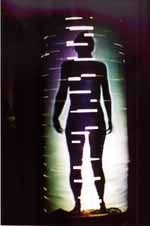
still from "wholey," projected image on spinning cylinder, 1999
statement
My artwork is concerned with what happens when different rates of change collide. I employ techniques of film-style “special effects,” but to ends other than those of traditional narrative cinema. I focus on poetic possibilities in time-based media, an approach counter to the mainstream.
John Berger wrote that traditional, mainstream narratives are always battles that end in victory and defeat; but poems, as an alternative literary form, “cross the battlefields, tending the wounded, listening to the wild monologues of the triumphant or the fearful,” promising that “what has been experienced cannot disappear as if it has never been.” My recent pieces reflect on moments and witness experiences. The importance of witnessing is deeply felt, a result of living in post-Katrina New Orleans.
The animations I create for installation often involve wall and floor projection, and sometimes sculptural elements. Images for projection are built by compositing and animating moving images and still elements digitally. The real and virtual combine to form a hyperreal space, and are created with gallery presentation in mind, but are sometimes shown theatrically. These composite images function symbolically and suggest internal states of the psyche.
Digital imaging and compositing are tools that allow me many options when exploring the blurry border between mental states, outward reality, and interactive digital worlds. Getting rid of the rectangular frame of reference -- the single window, the single point of view -- is important to me, as is integrating imagery into specific sites. While working, I think about media theorist Gene Youngblood’s idea that alternative or “expanded” cinema is an effort to manifest our consciousness outside of our minds and in front of our eyes. A recurring question is : what does consciousness look like - what form can it take visually?